Samarth Portal Admit Card 2026: Download, Release & Error Guide
A Samarth admit card appears only after the university’s examination administration generates and releases it. The official evaluation documentation states that students cannot preview an admit card before official release; it becomes visible only when the administrator publishes it.
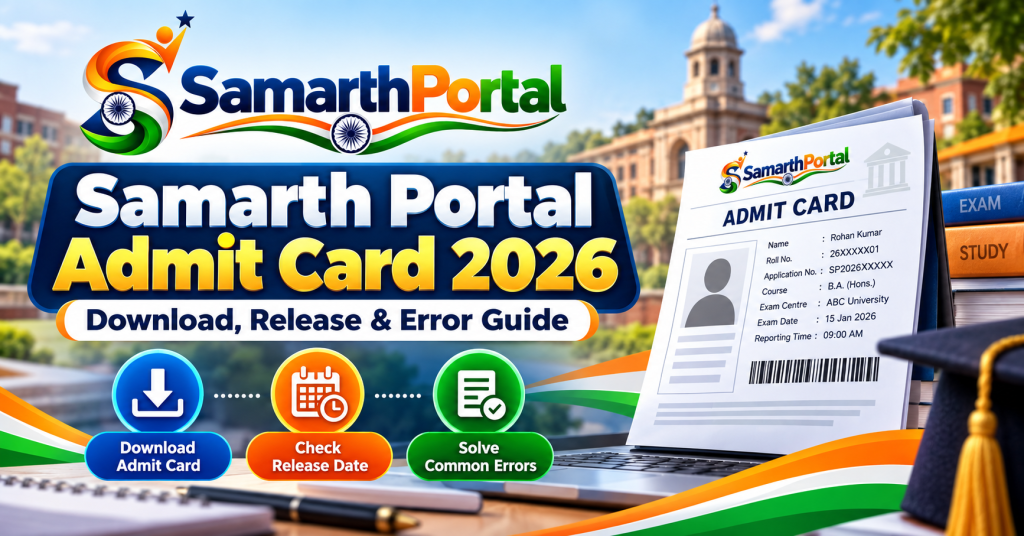
This guide focuses on the practical student intent behind samarth portal admit card and related searches. It explains what the Samarth platform itself supports, where the university controls the rule, how to troubleshoot safely, and when you need the institution rather than another browser trick.
When Is a Samarth Admit Card Available?
Universities release admit cards according to their own examination calendar. The portal can be working perfectly while the admit-card option remains absent because the exam office has not published cards yet. Always check the current examination notice first.
Generation and release are separate administrative steps. An admit card can exist in the backend for verification before students are allowed to see it. This is why asking classmates from another programme or semester is not enough; release can differ by examination session.
How to Download the Admit Card
Log in to the official student portal. Open the Examination or Admit Card section available for your session. Select the relevant examination if needed and click View/Download/Print. Save the original PDF to your device and open it before leaving the portal.
Check name, photograph, enrolment/roll number, programme, semester, examination centre, subject/paper list, dates, reporting time and instructions. Print it in the format required by the university. If a colour print is required, follow the notice rather than a generic recommendation.
Admit Card Not Showing
Confirm the release notice and your exam-form status. Check that course registration and examination fee are complete, and that the form is submitted/verified where required. Some institutions can withhold admit cards when eligibility or fee clearance is pending.
If other students in the exact same programme/session have cards and yours is missing, contact the exam section quickly with enrolment number, exam form/receipt and screenshot. Do not wait until the exam morning.
Wrong Details on the Admit Card
Do not edit the PDF yourself. A locally edited name or subject does not correct the official examination record. Report the error to the examination office/college using the university’s specified correction process. Keep written proof of the request and download the corrected card after the portal record is updated.
Pay particular attention to paper codes and examination centre. A small spelling issue may still require correction, but a wrong paper/centre can directly affect attendance and evaluation.
Download Problems
If the View/Download button does nothing, allow pop-ups for the official domain, try a desktop browser, clear only the affected site session if necessary, and check whether the PDF opened in a new tab. Avoid third-party “admit card download” websites that ask for your credentials.
If the server is overloaded near release time, retry later. Repeatedly clicking can create multiple tabs but will not speed up the server.
What to Carry on Exam Day
Follow the admit-card instructions and university notice. Common requirements include the printed admit card and a valid university/government photo ID, but the exact rule is institution-specific. Do not bring items prohibited by the examination instructions. Reach the correct centre early enough to resolve room/seat questions.
How University-Specific Samarth Portals Change the Answer
One of the biggest mistakes in Samarth content is pretending that every higher-education institution runs the same student experience. The platform provides common building blocks, but universities choose the modules, dates, fees, identifiers, admission routes and support contacts. That is why this guide does not publish one “universal” password, document-size table, fee amount or deadline.
For example, some older university guides on this site show a clear student portal and a separate admission portal; others use a state admission portal; some expose a Samarth eGov domain that is primarily administrative. Use those university-specific pages to find the correct destination before following the general troubleshooting steps in this article.
Safe Samarth Checklist Before You Submit Anything
Check the domain and university name
Read the browser address bar. Confirm that you are on the exact university/Samarth domain published by the institution. A familiar Samarth design is not enough, because hundreds of institution-specific portals can look similar.
Check your role and academic session
Confirm whether you are an applicant, enrolled student, employee or another user. Also verify the academic year, semester, programme and admission/examination session. Using the correct credentials in the wrong role or cycle can still produce an error.
Preview data and files
Before Final Submit, Freeze, Lock, Confirm or Pay, preview the complete record. Check names, numbers, programme choices, course codes, uploaded documents and fee heads. Save acknowledgements immediately after successful submission.
Protect credentials
Never send your password or OTP to a third party. Do not enter credentials into a page opened from an unknown message. On shared computers, use a private window if possible, sign out fully and clear downloaded sensitive files.
When a Problem Is University-Side Rather Than Browser-Side
Browser troubleshooting helps with captcha rendering, stale sessions, cached pages and local script issues. It cannot create a missing enrolment record, change university marks, release an admit card, approve a document, reconcile a fee manually or reopen a closed academic window. If the problem involves institutional data or policy, contact the university with precise evidence instead of repeatedly clearing the browser.
A useful support request includes the official portal URL, programme/session, student/application identifier, the exact step that failed, the full error text and the approximate date/time. If a transaction is involved, include the reference number and amount but never include OTP, PIN, CVV or password.
2026 Accuracy and Freshness Note
This guide was reviewed on 31 August 2026 against current Samarth documentation and the university-specific portal architecture already verified for the older posts on this site. Stable platform concepts such as New Registration, login, OTP verification and configurable university modules can remain consistent, but admission dates, examination windows, fee amounts, document limits and helpdesk contacts can change quickly. The newest official university notice always overrides an older article or screenshot.
Older University Samarth Posts to Check
These are older university posts already published/planned on this site. They are linked here because the exact portal route and university-specific workflow matter. This new guide does not link to any of the other new task guides in this batch.
- ASTU Samarth Portal 2026
- KMCLU Samarth Portal 2026
- PRSU Samarth Portal 2026
- DSMNRU Samarth Portal 2026
- Bhattadev University Samarth Portal 2026
Student Decision Tree: What to Check Before You Try Again
Step 1: Identify whether you are an applicant or an enrolled student
An applicant usually works inside an admission or counselling portal and may log in with an application number, CUET identifier, registered email or another admission credential. An enrolled student normally works inside the university student portal and may use an enrolment number, examination roll number or institution-issued username. Mixing the two is one of the most common reasons a valid credential appears to fail.
Step 2: Match the task to the correct module
Write down what you are actually trying to do: register for the first time, log in, reset a password, upload a document, submit an examination form, download an admit card, view a result, make a payment, raise a grievance or contact support. Then read the current university notice for that exact task. A university can use Samarth for one task and another official system for another task, even in the same academic session.
Step 3: Confirm that the activity is open for your programme and session
Many Samarth actions are time-bound. Course selection, examination forms, admit cards, results, fee demands, corrections and counselling rounds can be opened only for selected programmes, semesters or batches. If the portal works but the button you expect is missing, verify the opening date and eligibility before assuming a technical fault.
Step 4: Check prerequisites
Some actions depend on an earlier action being complete. A university may require profile verification before registration, course selection before an examination form, fee clearance before an admit card, or an approved application before a payment demand appears. Look for Draft, Submitted, Verified, Paid, Approved, Released or similar workflow statuses. The exact words differ by module, but the principle is the same: a later action can remain unavailable until an earlier one is complete.
Step 5: Save evidence before changing anything
Before resetting, resubmitting or paying again, save the current status. Take a screenshot of the page heading and exact error, write down the URL and time, and save any transaction or acknowledgement number. This evidence lets the university distinguish a browser issue from a record or payment issue. It also protects you if a deadline passes while the problem is being investigated.
Mobile vs Desktop: Which Is Better for Samarth?
Many routine Samarth actions work on modern mobile browsers, but a desktop or laptop is often safer for long forms, multi-document uploads, PDF previews, course-selection tables and payment troubleshooting. A larger screen makes it easier to check full course codes, filenames and status messages before submission.
If you must use a phone, keep the browser updated, avoid switching repeatedly between many apps during payment or OTP verification, and download important PDFs immediately. For uploads, confirm that the phone has not automatically converted an image into an unsupported format. If a button or table appears cut off, switch to desktop mode or use a computer rather than guessing what is hidden off-screen.
How to Verify a University Notice Before Acting
Check the publishing domain, notice date, academic session, programme, department and deadline. A notice from the correct university can still be irrelevant if it belongs to last year or another course. Open the notice from the university’s current official website wherever possible rather than relying on a forwarded PDF with no source page.
When a notice contains a Samarth link, compare the domain carefully with the link you have bookmarked. Universities sometimes create separate subdomains for a new admission cycle or a specific entrance route. The newest official notice should take priority over an old saved link.
What Not to Do When Samarth Is Not Working
- Do not create multiple accounts with different emails unless the university specifically instructs you to.
- Do not keep requesting OTPs every few seconds.
- Do not guess passwords based on DOB, mobile number or public “default password” formulas.
- Do not pay the same fee repeatedly because the first status is temporarily pending.
- Do not edit downloaded admit cards, results, receipts or ID cards to “correct” official data.
- Do not upload random low-quality files just to get past validation.
- Do not share OTPs, passwords, card PINs or CVV with unofficial helpers.
- Do not assume another university’s Samarth rule applies to yours.
How to Escalate a Samarth Issue Without Losing Time
Start with the office that owns the data. Admission questions go to the admission team; enrolment and profile issues usually go to the academic/student section; examination forms, admit cards and results go to the Controller of Examinations or examination cell; payment reconciliation goes to the relevant finance/admission/exam support team; and purely technical access problems may go to the university IT or Samarth cell.
In your message, state the problem in one sentence, then provide the programme/session, application or enrolment number, exact portal URL, error/status, date and time. If you already contacted another office, include that ticket or reference. Ask for a specific outcome—for example, “Please verify whether my enrolment record has been activated,” or “Please confirm whether transaction XYZ has been received.” Clear requests are easier to route and answer.
When the deadline is today
Keep evidence that you attempted the action before the deadline. Take screenshots with the visible error/status, save the notice, and contact the official helpdesk immediately through a traceable channel such as email or ticket. Do not rely only on a phone call when the issue could later require proof of timing.
When the issue is resolved
Log in again from the official portal, complete the pending action, and download the final acknowledgement. Do not assume an email saying “resolved” means the academic form, payment or registration is automatically complete. Verify the final status in your own dashboard and keep the updated receipt or PDF.
Samarth Portal Admit Card FAQs
What is the correct way to use samarth portal admit card information?
Start from your university’s official Samarth or university website, confirm the portal role and current session, then follow the relevant steps in this guide. University-specific rules override generic advice.
Is there one Samarth rule for every university?
No. Samarth is configurable, so institutions can use different portal URLs, identifiers, modules, fees, upload limits, dates and support contacts.
Should I create a second Samarth account if something fails?
Usually no. First check the portal, identifier, registration/reset status and university record. Duplicate accounts can make record matching harder.
Can an unofficial agent fix my Samarth account?
Do not share passwords or OTPs with unofficial agents. University-side academic and identity records should be handled through official university/Samarth support channels.
How current is this guide?
It was reviewed on 31 August 2026. Time-sensitive university dates and fees should always be checked against the newest official notice.
Practical Record-Keeping for Samarth Students
Create a secure folder for each academic session. Keep admission forms, enrolment or registration certificates, fee receipts, course-selection acknowledgements, examination forms, admit cards, grade cards, correction requests and important university notices. Use clear filenames that include the semester or date. This makes troubleshooting easier because you can prove what was submitted and when.
Bookmark the official university student portal after verifying it from the university website. Searching for the portal every time increases the chance of opening an outdated admission cycle, a staff login, an unrelated university or an imitation page. A bookmark does not replace checking fresh notices, but it protects routine login navigation.
How to Take a Useful Error Screenshot
Capture the page heading, exact error text and enough of the browser address bar to identify the official domain. Hide passwords, OTPs, card details and sensitive document information. For a payment problem, separately record the transaction ID and amount. For an examination issue, note the programme, semester and paper/course code.
How to Decide Whether to Wait or Contact Support
Wait briefly for delayed OTP delivery, gateway reconciliation or temporary high-traffic loading. Contact support when a deadline is approaching, your university record is missing, recovery contact details are wrong, a core academic field is locked/incorrect, a payment remains unresolved, or a released exam/result service is missing only for your account. The university owns those records and can investigate them directly.